






|
Home ›
Products & Solutions ›
System Power Noise Reliability ›
PakSi-E
PakSi-E
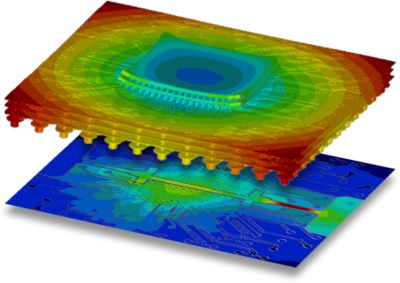
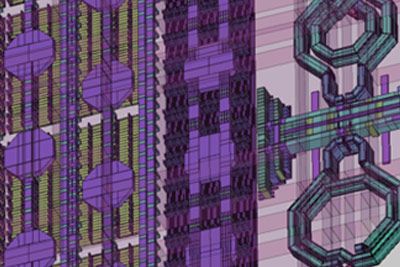
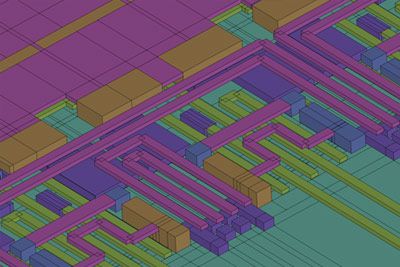
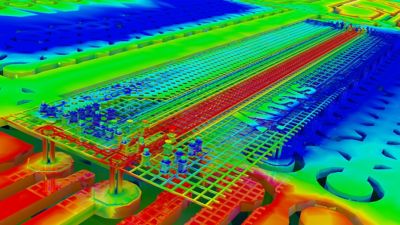
PakSi-E is a versatile 3D quasi-static electromagnetic simulation tool for electronic packaging. With this user-friendly tool, engineers and designers can address and resolve electrical performance issues in their IC packaging designs in a timely manner. 3D RLGC Extraction of Whole Package with Restart PakSi-E is the only 3D quasi-static extraction tool on the market that provides whole package RLGC parasitic extractions. As shown below, design features like wires, vias, solder balls and pads must be modeled in a 3D model to generate accurate SPICE sub-circuits.  PakSi-E also has a restart feature so that users can stop a whole package extraction in the middle and resume the extraction later, from the previous step. With this unique feature, users of PakSi-E can have precise RLGC values for each and every net of their design to ensure sound signal and power integrity. Back to Top  Versatile and User Friendly Interface Although 3D modeling is important to parasitic extractions, building and editing a 3D simulation model can be quite tedious and time consuming. PakSi-E provides and easy-to-use graphical user interface for package designers to build a 3D model. An average PakSi-E user can learn and run PakSi-E on their actual designs in less than 2 hours. PakSi-E automatically builds 3D models after users have provided, through various on-screen tables and pictures, the geometric and material information. Shown below are illustrations for the assignment of external ground planes and solder balls.  Back to Top  Fully Automated Parasitic Extraction As illustrated below, PakSi-E first builds detailed 3D models based on input CAD design files. The 3D model building, including boundary conditions assignment, is fully automatic in PakSi-E. It then solves the quasi-static Maxwell equations and obtains electrical and magnetic fields of the 3D models. From the resulting EM fields, PakSi-E extracts the RLGC parasitic parameters and generates SPICE models for subsequent signal integrity simulations.  Back to Top Multi-port Power and Ground Nets Extraction With the powerful automatic finite element mesh generation engine, PakSi-E can simulate complex power and ground nets accurately. As illustrated below, geometric details such as holes in a plane, vias, and solder balls are all modeled precisely by PakSi-E. These small geometric features can significantly affect characteristic behaviors of a power or ground net. For simultaneous switching noise simulations, it is often necessary to extract multi-port parasitic parameters of the power and ground nets. PakSi-E’s Multi-Port module allows users to assign port configurations, (active, float, or ground) of any given multi-port net to extract the RLGC parameters of the target ground or power net. In addition to generating RLGC parasitic parameters of the ground and power planes, PakSi-E also provides users with voltage drops and current densities of the power and ground nets.  Back to Top  Output Results PakSi-E provides the following outputs from the power and ground network extraction. - RLGC matrices
- SPICE sub-circuits
- Whole package IBIS models
- W-Element models
- SDF delay models
- Signal integrity parameters: S, Y, Z, crosstalk ratio, etc.
Back to Top  CAD Interfaces PakSi-E supports Gerber, Cadence Allegro (.mcm, .sip), Encore BGA, Mentor Graphics MCM Station and Zuken CR-5000 package designs. Back to Top 
|